|
In memoriam of
Nicolas, a plaque, a monument
A Bastille Day Tribute to Nicolas Peltier
July fourteenth will forever be a memorable
date for me. Along with my wife Dorothy, our youngest son Chris and our
three-year-old grandson Nathan, it was on this day that I recently
attended the unveiling of a plaque dedicated to our ancestor Nicolas
Peltier, which took place in the hamlet of Germonval, part of the commune
of Gallardon, France. Also present at the dedication ceremony that day
were “not-too-distant cousin” Benoit Pelletier-Shoja, from Nashua, New
Hampshire, and “long lost cousin” Jacques Pelletier, 81, a native of
Gallardon now living in nearby Chartres. Also in attendance were Pascal
Pelletier and his spouse Lise Lapointe, from Saint-Amable, Quebec;
although not directly descended from Nicolas Peltier, they were there
representing the Association des familles Pelletier Inc.
The day began with a pre-ceremony gathering
in front of Gallardon’s town hall, at the Place du Jeu de Paume. Present
were the mayor of Gallardon, Mr. Guy Beaufils, Ms. Florine Perry, who had
organized the day’s program of events, as well as various other Pelletier
and Peltier cousins. I was pleasantly surprised by the display of American
and Canadian flags waving along with the French and European Union flags
that stood out from the second story of City Hall. After a quick
headcount, our festive group proceeded to Germonval, where the dedication
ceremony began promptly at 11 o’clock. Before a crowd of some thirty or
forty people, including local journalists from two local newspapers, Mayor
Beaufils, Pascal Pelletier, Benoit Pelletier-Shoja and I each made a brief
speech before being joined by my son Chris and grandson Nathan for the
actual unveiling of the plaque, which had been draped by a French flag all
this time. On the count of three, we six pulled it away, revealing a
beautiful marble plaque etched with golden lettering. Here is an English
translation of the French inscription:
 |
 |
 |
 |
|
This plaque is located in Germonval,
Gallardon, France N48 31.822 E1 42.242 |
It was here in Germonval that Nicolas Pelletier was born
September 2, 1594. Having left one day in the year 1636 to conquer “the
new world,” he co-founded several large cities in Canada and America.
After this, Ms. Perry invited everyone to continue on to the Gallardon
city park for a reception that included champagne, fruit juices, and other
refreshments. Gifts of appreciation were exchanged all around, between Mr.
Beaufils, Ms. Perry and her fiancé Éric Blaise, Pascal and Lise, Benoit,
and Dorothy, Chris and myself.

Following this reception was an invitation-only luncheon at a local
restaurant and crêperie called the Entr’Acte Café. How could you go wrong
with succulent confit de canard (duck conserve), ample bottles of Loire
wine, fresh fruit, and fresh crêpes for dessert! It was magnificent!
After lunch, local historian Maurice Vié led everyone on a walking tour
through the narrow, winding streets of Gallardon, pointing out and
explaining several historically significant sites. Three main points of
interest were the ruins of an early twelfth-century tower partially
destroyed in 1421, a carved-façade timber-frame house constructed in the
sixteenth century, and last but not least, St. Peter and St. Paul Church,
which was begun in the 11th century and finally completed in the 16th
century. Some of us “brave souls” in the group even climbed to the top of
the church’s bell tower, where we saw the many exposed timber frames that
support the roof, and we carefully walked along the beams holding up the
ceiling of the sanctuary. This part of the church now serves as a large
aviary for the pigeons that fly in and out through holes in the fenced
windows.
After our visit to the church and the tower,
the group proceeded to the local tourism bureau, which houses a small but
impressive collection of prehistoric tools and pottery discovered in and
around the Gallardon.
At this
point it had already been an intense morning and afternoon, so we all
decided to take a break and return to our respective lodgings before
regrouping at the park later that evening for the outdoor dinner; you
could call it a picnic, but it was closer to a feast. It was, after all,
Bastille Day. The friendly atmosphere of the meal lent itself to relaxed
conversation with our many tablemates. For the benefit of our French
hosts, friends and cousins, Benoit even got out his pen and traced –
literally, on our paper tablecloth – the life and migrations of Nicolas
Peltier and his family in New France.
Before we knew it, it was 11 p.m. and time for the fireworks. Several
hundred people were already swarming in and around the parking lot, and
more were on their way, while we were escorted inside the fence to our
“VIP seating,” front and center for the synchronized music and firework
display, which was not-so-coincidently entitled “The Conquest of the New
World.” It was an impressive program, and a fitting end to an impressive
day!
This was a memorable trip from beginning to end. We were received like
friends and treated like family, and perhaps the most enduring aspect of
our voyage is this friendship which we have forged with the people of
Gallardon. We are already looking forward to our next visit!
William
H. Peltier of Watkinsville, Georgia
with Benoit Pelletier-Shoja of Nashua, New Hampshire
Sillery on September 12, 2005
 |
IN MEMORY OF
Nicolas
Peltier
AND
Jeanne de
Vousy
THE FIRST PELLETIER FAMILY
TO SETTLE IN NEW FRANCE.
Originally from the
Parish of Saint-Pierre Saint Paul
of Gallardon in Beauce (France), they arrived in this country on
June 11, 1636, accompanied by their sons Jean and François. Living
first at the Habitation of Québec City, they settled
on the côte Saint-François-Xavier in Sillery about 1645.
Governor Charles Huault de Montmagny granted to
master-carpenter Nicolas Peltier 50 acres of land on
September 12, 1645. Father Jean de Quen, Superior of the
Company of Jesus in New France, granted him another
50 acres in May 1659. This monument rests on a
part of the lands bestowed upon the Peltier family.
The Pelletier Family
Association, Inc.
September 12, 2005. |
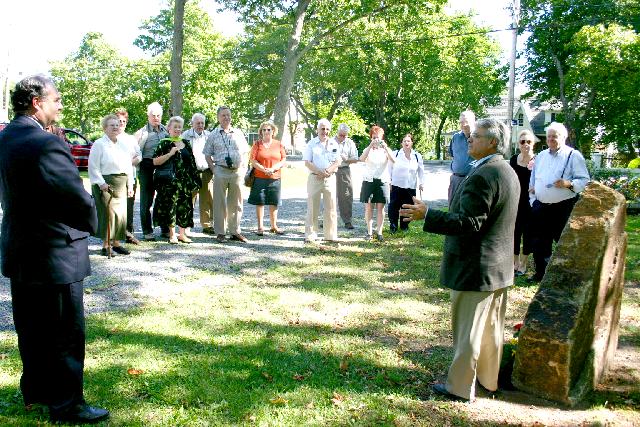
On 12 September 2005, the Pelletier Family Association, Inc. dedicated a
monument on a part of the land granted to Nicolas
Peltier in 1645. This monument is located at the maison Hamel-Bruneau,
2608, ch. St-Louis. Sillery (Quebec) N
46.46.005 W071.16.376
As part of the dedication ceremony, Benoît Pelletier Shoja, one of Nicolas
Peltier's descendants and avid Peltier family researcher, gave a talk on
the research he recently made in France.
 |
"
Mr. President and members of
the Sainte-Foy/Sillery Administrative Council; Mr. Dumas, Ms.
Blais-Gosselin; members of the Pelletier Family Association; cousins;
friends; guests:
A great emotion fills my heart as I look upon this monument honoring
these hardy Québé-cois pioneers, our ancestors Nicolas Peltier and
Jeanne de Vousy. In the name of their descendants throughout the
world, I salute you. I thank you with all my heart for this
celebration of the lives of our forbears. This monument, which sits on
a portion of the land con-ceded to this family 360 years ago today,
will serve as a reminder to all those who see it that they are
standing in the very cradle of the Peltier family in North America.
Despite the gap between their
lives and my own - four centuries and eleven generations - I am forever
aware of the extraordinary life of this couple. One spring day in the year
1636, Nicolas and Jeanne undertook a voyage of great uncertainty across a
vast ocean, to realize their ambitions in the hostile and unforgiving
territory of New France, where they eventually succeeded in establishing
their family. Between 1633 and 1649 they had eight children, each of whom
reached adulthood. In 1681, their progeny included three sons, five
daughters, over seventy grandchildren and even several great-grandchildren;
fifty years later it was nearly a thousand descendants. The Peltier family
was at that time the tenth largest Québécois "root family," which is no
small claim. As for Nicolas, he lived to about the age of eighty-one,
which is, without exaggeration, extraordinary for the time. His line has
perpetuated and his descendants continue to prosper, as much in Canada as
in the United States, as well as throughout the world. |
To conclude this first part of
my presentation, many thanks once again to the Administrative Council of
Sainte-Foy/Sillery for having authorized the installation of this monument
here at this glorious site, the Hamel-Bruneau House, on the land that once
belonged to Nicolas Peltier. Thanks also to all those who helped make this
extraordinary day possible, in particular Denis Pelletier, Guy R.
Pelletier and Marcel Pelletier, of the Pelletier Family Association, and
Éric Dumas, director of historical facilities for Sainte-Foy/Sillery.
|
 |
 |
I would now like to speak to you about the
week in July 2005 that I spent at the Eure-et-Loir Departmental Archives,
situated in Chartres, France, in pursuit of Nicolas Peltier. I would also
like to present the results of my research there.
First, in order to undertake this task, I based myself uniquely upon what
was already known about the origins of this ancestor, according to the
archives of New France. The parish register of Notre-Dame de Québec
reveals that master-carpenter Nicolas Peltier was originally from the
parish of Saint-Pierre Saint-Paul de Gallardon in Beauce. The census of
1667 indicates that he was born about 1590. And, very important, different
notarial contracts prove that he could sign his name.
Conversely, neither his parents' names nor his date of birth appear in
documents available at the National Archives of Québec; no genealogist has
ever known these two pieces of important information.
In addition, once at the Eure-et-Loir Archives, I limited my research to
the registers of notaries active in Gallardon in the early seventeenth
century. Given the enormous amount of documents that this research
entailed, I could not read each contract line by line. Instead, I paid
close attention to the signatures at the end of each instrument, careful
not to miss my ancestor's scrawled endorsement.
On my first day at the Archives, Monday,
July 18, I consulted six volumes of bound notarial contracts; each
register contained about 400 or 500 pages. To my great disappointment,
although different Pelletier signatures abounded in these registers, I
found no trace of Nicolas Peltier. The next day, during eight consecutive
hours of research, I consulted thirteen such registers, page by page.
Again, I encountered many Pelletier signatures, but not the one I had come
to find.
The morning of Wednesday, July 20, the director of the Eure-et-Loir
Archives, Michel Thibault, whom I had contacted before visiting France,
gave me a personal guided tour of the archives facility. The building is a
former seminary, constructed in 1722, and has served as an archival
repository for the last century. Mr. Thibault admitted that this was
perhaps the worst possible environment in which to effectively conserve
the documents in his care. Consequently, the archives are now in the
process of being moved to a new state-of-the-art facility. Now, because I
am employed at the New Hampshire State Archives, Mr. Thibault received me
as a colleague, hence the guided tour. In addition, he also gave me access
to several one-of-a-kind documents from the seventh, eighth and ninth
centuries, which no long circulate publicly, as well as different medieval
maps of Gallardon and its environs.
After this warm welcome and splendid visit, during which I was able to
meet and talk with different French colleagues, that afternoon I returned
to leafing through the registers of seventeenth-century Gallardonian
notaries. At the end of my third day I had already consulted thirty
separate notarial registers; at a conservative estimate this is over
10,000 individual notarial contracts, ranging in dates from 1606 to 1630.
With only two days remaining at the Archives, I still had not found any
trace of Nicolas Peltier.
All the same, I had very good reason to be happy. At the beginning of the
year, in preparation for my visit to France, I had written Mr. Thibault to
ask him about the Eure-et-Loir Archives. In one response he indicated that
it was possible to consult digitized microfilmed copies of the état civil
(vital records) of every commune in the department, including Gallardon,
up to 1853. Because I was planning to spend only one week at the Archives
and wanted to restrict my research to original notarial registers, I
ventured asking Mr. Thibault if it would be possible to purchase a CD-ROM
of Gallardon's earliest parish records. To my great joy he said yes;
because I had traveled some 5,000 kilometers to reach Chartres, there was
no problem. Imagine my great surprise when he added, "But I have no right
to make you pay"!
So, that day Mr. Thibault offered me not one, but three CD-ROMs containing
over 1,720 images of Gallardon's parish registers, from 1578 to 1670! What
a magnificent finish to my third day at the Archives.
Now, after three days of disappointing research in the notarial registers,
when I opened my first volume of contracts early Thursday morning, July
21, little did I know what I was going to find in my first registry of the
day - a registry that I had not planned to consult, because the archives
index indicated "mauvais état" (bad condition).
There, in the minutes of a notary name Jean Fullone, for the year 1612, at
the end of a contract dated February 29, I encountered, finally, the
signature of Nicolas Peltier!
Reading for a first time the text of this contract which my ancestor had
signed, I realized that this document was very important - indeed
invaluable - for several reasons. First, it bears our ancestor's
signature, which permits us to prove irrefutably and therefore
definitively that this is indeed Québécois pioneer Nicolas Peltier.
Moreover, it reinforces what we already knew about Nicolas, namely that he
came from the parish of Gallardon.
But what sort of contract was this?
Among other words, I thought I could distinguish "baille" (third-person
singular present-tense form of "to lease") which immediately made me think
that Nicolas was agreeing to rent property. But I did not see any other
words typically used in leases or land sale agreements.
Only later, with help from Mr. Thibault, did I learn that I had in actual
fact found an appren-ticeship contract. That is to say, young Nicolas was
being leased as an apprentice and student to a master carpenter, who in
turn agreed to instruct him in the art of carpentry, which trade Nicolas
would later continue in New France.
This master carpenter was named Michel Delaval, and the contract bears not
only his sig-nature, but also his mark. Beneath his signature he traced
the outline of a broadaxe, the indispensable tool of a carpenter for
hewing posts and beams. This identifying mark would have also likely
appeared on any framework or other timber structure he had constructed.
In addition, the contract shows that Delaval lived in Épernon, a town
situated ten kilometers from Gallardon, where he would have quite probably
brought Nicolas during his apprenticeship. This constitutes the first
indication of the early migrations of our ancestor before his arrival in
Québec.
All the same, the ultimate reason that this document is so precious to us
is that it bears the names of Nicolas Peltier's parents! This would later
serve as the key to opening my re-search in the parish registers of
Gallardon.
Now, having uncovered this contract that morning, it was not until five
o'clock that afternoon that I was able to meet with Mr. Thibault to
continue reading the text, and to confirm my limited interpretation
thereof. He eventually invited colleague Brigitte Féret, and we three
together were able to decipher a large part of the document. However,
given the advanced hour, we decided to put the contract aside until the
next afternoon, as Mr. Thibault would be absent that morning.
The next day I spent my time carefully studying, deciphering and
transcribing the text. Although about twenty words remained illegible,
mostly in the conventional notarial closing, with what we had been able to
decipher the previous day, I was able to grasp the principle elements:
Nicolas' father having died sometime earlier, our young ancestor was
unable to continue the paternal trade. His mother, likely unable to
provide for her son, had to lease him to Michel Delaval, and this, during
four years. Delaval accepted to "teach, show and instruct" Nicolas "his
said condition of carpenter"… to "provide and ready his drink [and] food"
… to "provide heat"… and to "maintain clothing, linens and shoes," all at
his own expense. In return, Nicolas would be "required to serve the said
Delaval his master in his said condition and in all other licit and honest
affaires that he will be commanded without distrusting or elsewhere
serving […] during the said time"…
This is the interpretation ultimately arrived at by Mr. Thibault, Mrs.
Féret and myself, with additional help from Émilie Lebailly, on Friday
afternoon, July 22.
Now, this story - and my research - obviously does not end in France.
Remember the three CD-ROMs that Mr. Thibault had graciously given me! Once
I returned home, armed with Nicolas' parents' names, I set myself to "thumbing
through" the oldest Gallardon registers.
In the second register, which begins in 1591, I found not one, but three
of Nicolas' sisters - and older sisters at that. Nicolas was the fourth
child and the first son of his family. His parents ultimately had thirteen
children, which is to say nine daughters and four sons, between 1592 and
1610. I cannot however at this time confirm how many of these children
survived to adulthood.
The family's first child was baptized on
November 16, 1582. Her name was Simone, which happens to also be her
mother's name.
Next was Philippe, on October 18, 1593; and then Jeanne, on April 3, 1595.
Then, on June 4, 1596, it was Nicolas, sponsored by Nicolas Brebier, Éloi
Pelletier and Mathurine Moinaut, wife of Pasquier Pichereau, who was
himself a relative of the child's mother.
After Nicolas there was Marie, baptized March 11, 1598; and on February
10, 1599, a second daughter named Marie.
On July 11, 1600, another daughter named Jeanne was baptized, and on
January 23, 1602, it was second son Éloi.
On November 18, 1603, it was the family's ninth child and its third son,
Pierre, sponsored by Pierre Beauchesne, Nicolas Pelletier , son of Éloi
Pelletier, and Jeanne, wife of Claude Duboys. Now, it is possible,
although in no way certain, that this Pierre is the unidentified Pierre
Pelletier named in the contract drafted in Québec City on November 12,
1639, by notary Martial Piraube, in which Nicolas Peltier and Pierre
Pelletier, both carpenters, and mason Jean Éger report on the condition of
the house of the late Guillaume Hébert.
Later came Nathalie, on April 10, 1605; Marguerite, on November 10, 1606;
the family's last son, Philippe, on February 22, 1609; and finally, its
last child, Simone, on June 13, 1610.
In summation, much heretofore unknown information about the origins and
family of Québécois pioneer Nicolas Peltier has been brought to light. We
know that he had nine sisters and three brothers, as well as the name and
baptism date of each sibling. We know at long last when Nicolas himself
was baptized. We also know his mother's name and even the name of the
master carpenter who instructed him in the art of carpentry. So now,
finally, I can unveil the last piece of information that I have to reveal,
the name of Nicolas' father: François Pelletier.
I thank you all for your presence here this magnificent afternoon, and I
thank you for your attention. Thank you very much."
Benoit Pelletier Shoja,
e-mail :
LaFranceLaPerse@gmail.com
September
12,
2005
To learn about Benoit's finding in France,
please click HERE.
|


